
High Grade International Steel Sheet Piling, Vinyl Sheet Piling, Pipe Piling, Marine Mooring Systems & Steel Structures Supplier in Indonesia
PHONE : +62 21 83709257 | MOBILE : +62 811 980 376

Modular Steel Bridge Manufacturer in Indonesia
ESC Modular Steel Bridge - Panel Type (Bailey) System
PT ESC Steel Indonesia manufactures modular steel bridge and Bailey bridge systems for infrastructure, transportation, industrial, emergency access, and other demanding bridge applications. Designed around prefabricated steel components, ESC modular bridges provide a practical solution where efficient transportation, rapid on-site assembly, and adaptable bridge configurations are required.
ESC modular bridge systems use standardized steel truss panels, transom beams, reinforcing chords, bracing, decking, and connection components that can be configured according to different span and load requirements. The modular design makes the systems suitable for both temporary and permanent bridge applications.
ESC offers the ESC-HD-100 and ESC-HD-200 Bailey bridge systems, with configurations available for different bridge spans, widths, and design loads.

Modular Steel Bridge Characteristics & Features
Prefabricated
The components are manufactured in a factory setting, ensuring high precision and quality control.
Rapid Assembly
Due to their modular nature, these bridges can be erected quickly, minimizing disruption and construction time. Assembly can be done manually or with the aid of basic equipment.
Portable
These bridges can be easily transported to the construction site, often using standard shipping containers or flatbed trucks. Components can be handled and transported manually in remote areas.
Versatility
Modular steel bridges can be configured for various lengths, widths, and load capacities, making them suitable for different environments and uses.
Standardized Components
The bridge components are standardized, facilitating mass production and ease of assembly.
Simplicity
The design allows for quick and straightforward assembly by relatively unskilled labor, often within hours.
Lightweight Construction
Despite its strength, the Bailey bridge is relatively lightweight, which simplifies transportation and handling.
Scalability
Modular steel bridges can be extended or reinforced by adding additional panels and supports, accommodating various spans and load requirements.
Durability
Made from high-strength steel, these bridges offer excellent longevity and resistance to environmental factors.
Development and Design
The Bailey bridge was designed to meet the need for a portable, strong, and easy-to-assemble bridge that could support heavy loads. Its modular components include prefabricated steel trusses, panels, and decking units that are connected using bolts and pins. This design allows for rapid construction without the need for specialized tools or heavy equipment.
No questions asked, the ESC Modular Steel Bridge (Bailey) is indeed an engineering marvel. The first versions were light, and soldiers could assemble it within 24-hours. The bridge could support even the heaviest tanks for over a 60-meter span. Popular descendants of the bridge that are commonly used today include the many forms of Truss bridge, the Crane Mat bridge, and the Pedestrian bridge.

Construction Process
-
Planning and Design. The construction of a modular steel bridge begins with a detailed site survey and load analysis to determine the appropriate configuration and materials. The design phase involves creating detailed plans that specify the layout, assembly sequence, and required components.
-
Prefabrication. In the factory, components are fabricated according to the design specifications. This includes cutting, welding, and finishing steel panels, trusses, and decking. Quality control measures ensure that each component meets the required standards.
-
Transportation. The prefabricated components are transported to the construction site. Due to their modular nature, these components can be efficiently packed and shipped using standard transportation methods.
-
Assembly. On-site assembly involves the following steps:
-
Foundation Preparation: The bridge supports or abutments are prepared, often using concrete or steel foundations.
-
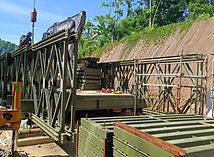
Panel Assembly: Steel panels and trusses are connected using bolts and pins. Depending on the span and load requirements, multiple panels may be joined to form longer sections.
-
Decking Installation: Once the main trusses are in place, decking units are installed to create the roadway surface. Decks can be wooden planks or steel sheets for light duty and thicker steel sheets or concrete for heavy duty use.
-
Accessories: Additional components, such as guardrails and surface treatments, are added to complete the bridge.


Inspection and Testing and Applications
Prior to conducting test loads to determine the static and dynamic behavior of a constructed Bailey bridge, a thorough evaluation of all parts and components is carried out by visual inspection. The purpose of this inspection is to verify the conformity of the structure not only to drawings and specifications but also the quality of workmanship and readiness to static and dynamic loading.
Load testing is a popular method of verifying the loadbearing capacity of bridge structures. The main advantage of load testing is its non-destructive nature and the minimum impact on the structure itself. Generally, load testing subdivides into two categories - static and dynamic tests. In a static test, observation focuses on structural response to the ballast of known parameters. The dynamic trial relies on the usage of artificial excitation of structure vibrations; the goal is to assess the real dynamic properties of the bridge under study in its actual or operational conditions. It is also called simulation.
Following the process, the overall integrity of the bridge is ensured as well as the welfare and safety of the public before opening the bridge to the intended use.
Military Uses
Modular steel bridges, particularly Bailey bridges, have been extensively used in military operations. Their ability to be quickly deployed and assembled makes them ideal for establishing supply routes, crossing rivers, and replacing destroyed infrastructure in combat zones.
Temporary and Permanent Infrastructure
Modular steel bridges are also used in civil engineering projects for temporary detours during construction or for permanent installations in remote or challenging locations. Their adaptability makes them suitable for both urban and rural applications.
Disaster Response
In disaster-stricken areas, modular steel bridges provide a rapid solution for restoring connectivity. Their quick assembly helps in delivering aid and supplies, as well as enabling evacuation and rescue operations.
Industrial and Commercial Use
These bridges are often employed in industrial settings to create access over obstacles such as railways, waterways, and pipelines. They provide a cost-effective and durable solution for various commercial needs.
ESC modular steel bridges, with their innovative panel-type design, offer a versatile and efficient solution for a wide range of applications. The Bailey bridge exemplifies the benefits of this approach, combining strength, portability, and rapid assembly to meet diverse infrastructure needs. Whether for military, disaster response, or civil engineering, these bridges continue to play a crucial role in modern construction and logistics.

ESC-HD-100 Bailey Bridge

The ESC-HD-100 Bailey Bridge, also known as a 321-Panel Type Bridge, is a modular steel bridge system designed for short- to medium-span applications and light to moderate loads. Its prefabricated structural steel panels are connected using steel pins, allowing components to be transported, assembled, dismantled, and reconfigured efficiently.
The ESC-HD-100 can accommodate a maximum free span of 51 m (167.3 ft) with a net deck width of 4 m (13.1 ft). Different bridge panel configurations and dimensions can also be custom-built according to project requirements.
ESC-HD-200 Bailey Bridge

The ESC-HD-200 modular bridge system provides increased span and load capability compared with the HD-100 system. With a panel height of 2.13 m (7 ft), the system can accommodate maximum free spans of up to 60.96 m (200 ft) in a single-lane configuration and 45.72 m (150 ft) in a double-lane configuration.
The system can accommodate design loads including HS-15, HS-20, HS-25, HL-93, Pedrail-50, and other project requirements.
Product Images



Useful Information
GET IN TOUCH
Expect a prompt and helpful response from our dedicated team. We value your time and aim to address your queries efficiently.


